
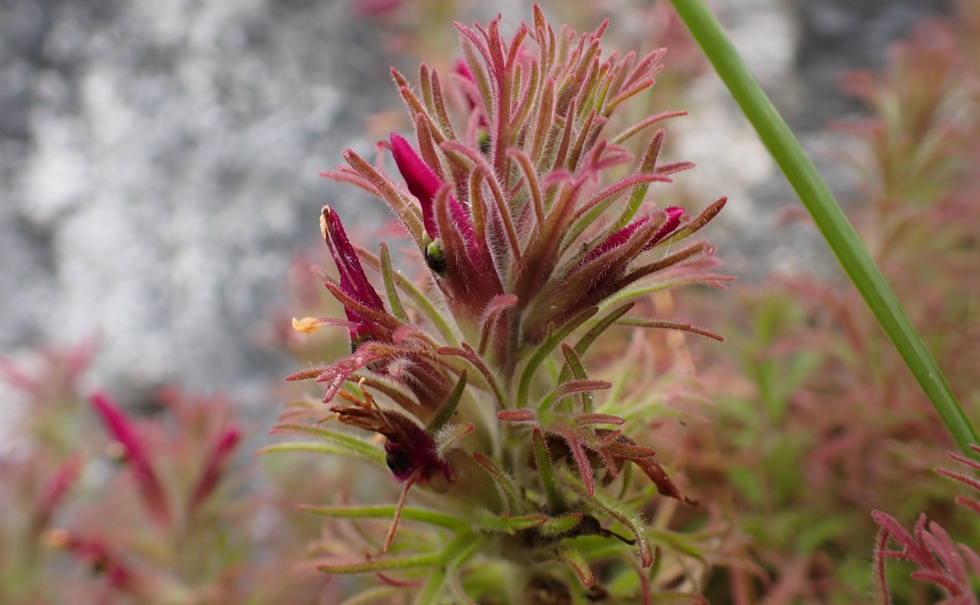
Researchers have described a new plant species in northern Peru. Castilleja isidoroi has so far only been documented in Amazonas and Cajamarca. Only six populations are known to science.
The species was scientifically described by J. Mark Egger and Daniel B. Montesinos-Tubée. The study was published in the journal Phytoneuron.
This plant is only found in northern Peru
Castilleja isidoroi belongs to the Orobanchaceae family and grows in the northern Peruvian Andes. Its vibrant colors are particularly striking: the floral areas range from scarlet to reddish-purple.
So far, the species has been found exclusively in Amazonas and Cajamarca. According to current research, it is considered endemic to this part of northern Peru.
The plant had long been in the archives
Curiously, specimens of the plant had been in existence for years. They were sitting in scientific plant collections but had not been classified as a distinct species.
Some specimens were merely labeled as Castilleja sp. or Orthocarpus sp. Others had been attributed to the known species Castilleja vadosa. Only a re-examination revealed that it is a distinct species.
Only six populations
Researchers do not yet know how rare Castilleja isidoroi actually is. Only six populations are known to date.
In one population in Amazonas, only 15 to 20 plants were counted across approximately 50 square meters. At one site in Cajamarca, the scientists found only a few scattered individuals. Further studies must show whether there are any as-yet undiscovered stocks.
Fire, livestock, and climate change could become a problem
The researchers cite several potential threats to the new species: overgrazing, fires, increasing settlement, and climate change.
The limited known distribution, in particular, could make Castilleja isidoroi vulnerable to changes in its habitat. The scientists therefore recommend investigating the species' conservation status more closely.
Why it is called Castilleja isidoroi
The name commemorates the Peruvian botanist Isidoro Sánchez-Vega (1938–2015). He was a professor at the Universidad Nacional de Cajamarca and studied the flora of the Peruvian Andes extensively.
As a Spanish name, the researchers propose “El Pincel de Isidoro” – “Isidoro's paintbrush.”
For science, the work is only just beginning. Researchers must determine how many plants actually exist, whether further populations are present, and how endangered the known stocks are.
Image source: Oficina de Comunicación de la Ciencia / Universidad Científica del Sur.


