
Huaca Bandera – the last great ceremonial center of the Moche
Huaca Bandera near Pacora documents a crucial phase at the end of the Moche period and the cultural transition that led to the emergence of the Lambayeque culture in northern Peru.
Travel conditions today at Huaca Bandera
Weather for Pacora, travel recommendations, and Perusino's tip. On open archaeological sites, sun, heat, and wind can be stronger than in the town center.
Weather today
Current conditions for Pacora are being retrieved.
Live update active.
Mind the sun and time of day.
Start in the morning if possible, bring water, and protect your head and skin from the intense coastal sun.
Visit at a Glance
- Region
- Lambayeque
- Best travel time
- Year-round, preferably in the morning
- District
- Pacora
- Culture
- Late Moche / Early Lambayeque
- Focus
- Monumental adobe architecture, wall decorations, elite burials, and the transition between Moche and Lambayeque
Area and classification: MINCETUR · Inventario de Recursos Turísticos
Places and experiences
Huaca Bandera at a Glance
Huaca Bandera is located west of Pacora in the lower zone of the La Leche-Motupe Valley. The Peruvian tourism inventory describes a large archaeological complex with monumental adobe platforms, walled areas, plazas, ramps, and other structures. Its dimensions indicate that this was not an isolated temple, but a significant political and religious center.
The temporal position of the site is particularly important. Research focuses on the late Moche period and the transition to the Lambayeque culture. This allows for an examination of how power, religious beliefs, burial customs, and monumental architecture changed on the north coast of Peru between the 8th and 10th centuries.
Huaca Bandera remains an active research and conservation site. Excavations, documentation, restoration, and laboratory analyses are combined. New findings can therefore continue to alter the scientific classification of individual areas.
Sights in the Region
All SightsCurrent News from the Region
All NewsImage Gallery
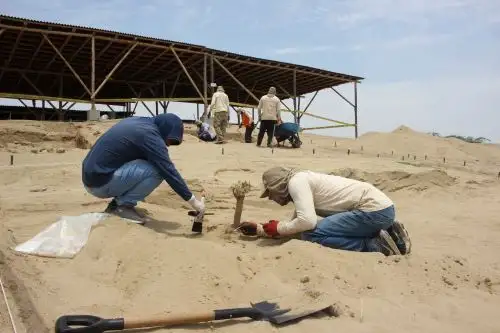


Why Huaca Bandera is Special
Huaca Bandera is important for the archaeology of northern Peru because the complex does not just document a single peak phase. The site shows changes within the late Moche tradition and, at the same time, developments that later became characteristic of the Lambayeque culture.
Polychrome murals, reliefs, burials, and complex spatial sequences make it possible to study religious rituals and political rule together. Controlled access points and separated functional areas show how social hierarchies were spatially organized.
Key Areas of Huaca Bandera
The complex consists of several monumental and functionally distinct zones. Platforms, plazas, ramps, walls, and corridors were altered and expanded over various construction phases.
Monumental Platforms
The large adobe platforms shaped the appearance of the center. They not only served as raised structures but also structured ceremonial processes and controlled access to particularly important areas.
Walled Compound 2
This walled area is one of the intensively studied zones. A main platform, forecourts, corridors, and various construction phases provide clues to the long-term use and reshaping of the center.
Plazas and Ramps
Plazas served as gathering and ritual spaces, while ramps connected different levels. Their location shows that movements through the complex were deliberately guided.
Murals and Reliefs
Preserved paint residues and decorated surfaces are among the significant findings. They provide insights into religious imagery and the symbolic decoration of representative rooms.
Burials and Elite Areas
High-ranking burials and special room forms indicate a social elite. Such findings help to understand how political and religious authority was represented at the end of the Moche period.
Transition to the Lambayeque Culture
Changes in architecture, ceramics, and burial customs show that the cultural transition was not abrupt. Huaca Bandera documents a phase in which older Moche traditions continued to exist while new forms emerged.
Events in the Region
To the CalendarArchaeological Highlights
Among the most important findings are monumental adobe platforms, multi-phase building complexes, wall decorations, and burials of high-ranking individuals. Together, they show that Huaca Bandera played a central role in the northern coastal region for a long time.
The connection of different artifact groups is particularly valuable. Architecture, ceramics, grave goods, and spatial organization can be evaluated together to provide a nuanced picture of social change.
Admission and Visit
Huaca Bandera is a protected archaeological research site. Regular tourist access to all areas is not guaranteed at all times. Excavations, restoration work, or protective measures may lead to the closure of individual zones.
Therefore, before planning a visit, it should be checked whether and to what extent a visit is possible. Visitors should only use designated paths and neither step on nor touch the sensitive adobe walls.
Opening Hours and Best Time to Visit
For Huaca Bandera, current visiting hours should be checked before arrival, as access and open areas may depend on research and conservation operations. Morning hours are particularly pleasant due to the open coastal landscape.
The Lambayeque region is dry for much of the year. However, unusually heavy rainfall can affect access roads and adobe structures. After periods of rain, protective measures may take precedence over tourist access.
Current Situation
Huaca Bandera remains an active archaeological research and conservation site. The responsible cultural institutions are working on documenting, evaluating, and protecting the site. Therefore, accessible areas and visiting conditions may change.
How Demanding is the Visit?
Physically, the visit is relatively easy because Huaca Bandera is located in the flat coastal plain. The biggest challenges are sun, heat, dust, and uneven terrain. Shade on the archaeological site is limited.
Travel requires more planning. The last section from Pacora leads into a rural area. Without your own vehicle, the round trip should be organized before driving to the site.
What to Pack in Your Backpack?
- sufficient drinking water
- headwear and sun protection
- light, closed shoes
- small daypack
- phone with offline map
- personal medication
- information on current visitor access
Accommodations in the Region
Affiliate link: The map is loaded by Stay22. PeruMagazin may receive a commission for bookings; the price remains unchanged for you.Stay up-to-date on Peru
Travel advisories and important information from Peru on the PeruMagazin WhatsApp channel.
Frequently Asked Questions about Huaca Bandera
Where is Huaca Bandera located?
The complex is located west of Pacora in the province and region of Lambayeque.
Why is Huaca Bandera significant?
The site documents the late Moche period and the transition to the Lambayeque culture.
How large is the site?
The Peruvian tourism inventory states that the archaeological complex covers an area of approximately 186.55 hectares.
Is Huaca Bandera always open?
Guaranteed continuous access to all areas is not assured. Current visitor access should be checked before traveling.
What should one bring?
Water, sun protection, headwear, and suitable shoes are advisable for the open coastal landscape.
Sources
- Ministerio de Comercio Exterior y Turismo del Perú – Inventario de Recursos Turísticos: Complejo Arqueológico Huaca Bandera
- Ministerio de Cultura del Perú / Unidad Ejecutora 005 Naylamp-Lambayeque – Research and Conservation Reports
- Agencia Andina – Archaeological Investigations at Huaca Bandera
- Image Sources: Agencia Andina / RPP Noticias